 Gather Marketing
I read Building a StoryBrand in a car dealership waiting room.
We had sold the truck the year before. I loved that truck. But the money was gone and the truck was gone and we bought a CRV that turned out to be a lemon. I was back at the dealership while they worked on it again, sitting in one of those chairs with the armrests bolted to the next chair, and I had Donald Miller's book in my lap.
A salesman walked past. Saw the cover. Said great book.
He was right.
---
What StoryBrand actually does
Most marketing books are versions of the same thing. Write better copy. Run ads. Build a funnel.
Building a StoryBrand is different because it does something the others don't: it puts the customer in the center and asks a question most businesses never answer. What is the story your customer is already living in? What are they afraid of? What do they need? And where do you fit?That question changed my work.
I spent seventeen years as a pastor. Before you preach, you figure out what's actually going on in the room. What people are carrying. What they won't say out loud. You can't reach someone without doing that work first.
StoryBrand formalized it for business.
The SB7 framework has seven parts. In practice, four do most of the work: who the customer is, what problem they have, why you're the right guide, and what to do next. Most small business websites fail all four.
If you run your site through the framework honestly, you get a clearer page. The headline stops being about you. The problem gets named. The plan becomes a plan. That is real and it works.
---
Where the framework stops
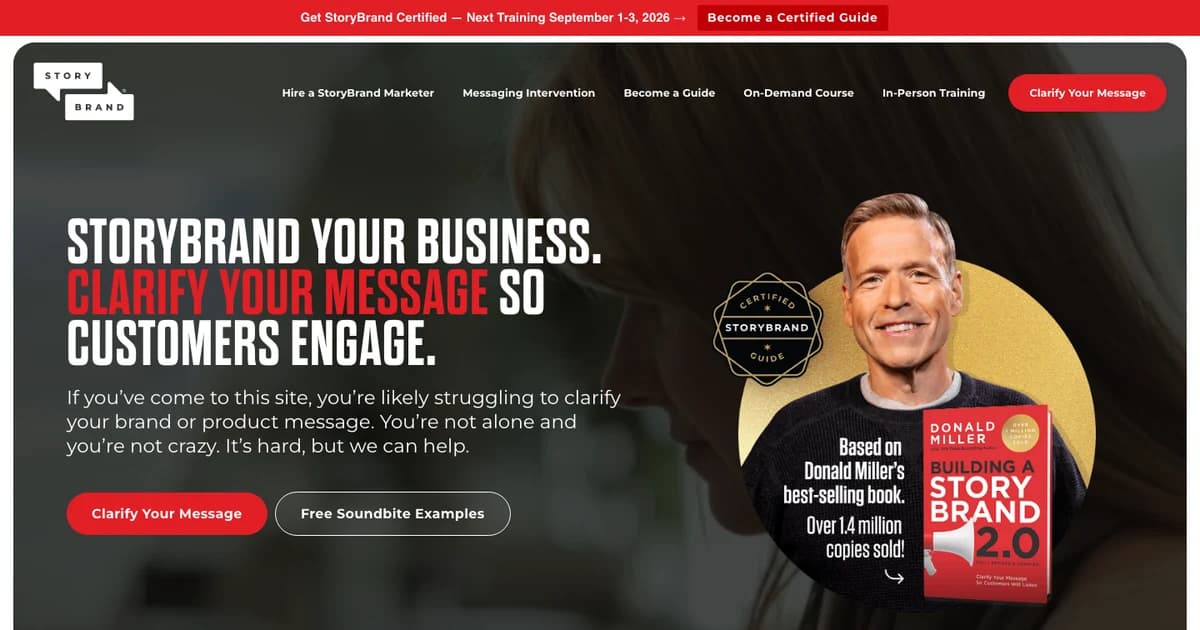
I audited storybrand.com this week. Scored it 38 out of 60.
The hero section is good. The problem work is good. But the nav had six options before a first-time visitor could make a single decision. Half of them used insider language only existing customers would recognize.
The SB7 framework is about narrative structure. Is the customer the hero? Does the story have a guide, a villain, a plan, real stakes? It addresses those things well.
What it was never designed to measure: the visual and proof layer.
The Plainspoken Blueprint scores six things: Hero, Problem, Plan, CTA, Photos, Proof. The first four overlap with StoryBrand. The last two, Photos and Proof, are where conversion actually lives.
A face next to a testimonial converts differently than text alone. A named result with a real person attached outperforms anonymous proof. Not because it looks better. Because the brain processes trust differently when it sees another human being.
You can write the StoryBrand narrative perfectly and still leave real conversion on the table if your testimonials have no faces.
All three StoryBrand-affiliated sites I scored this week had the same weakness. Photos: 2/10 across the board.
---
Why I'm not competing with Donald Miller
Donald Miller built his framework around big national brands. I built mine with Samuel Sawyer and Lewis Downing.
His subjects are brands. Mine are neighbors.
I've been reading him since Blue Like Jazz. There was a warning sticker on the cover at the Christian bookstore. I bought it because of the sticker. He was doing honest work about faith before that kind of honesty had a name, and he's been doing honest work ever since.
The Plainspoken Blueprint is not StoryBrand for small businesses. It's a different layer: story-first, where the framework emerges from actual people and places and moments, not from a template applied to the story. It adds what StoryBrand wasn't designed to address.
The frameworks stack. They don't compete.
---
The audit
I ran through storybrand.com live this week using a voice-following teleprompter and a browser-based recorder, both tools I built for Gather Marketing. No software download. No subscription. Just a browser tab.
Watch it above.
If you want to know where your site stands on all six lenses, book a Blueprint Session. I score your site before we meet.